6) Benicio:
Born in 1936 in the city of Rio Pardo, State of Rio
Grande do Sul, south of Brazil, José Luiz Benicio da Fonseca, aka Benicio, has had
a pivotal role in the success and in the popularization of Brigitte Montfort:
he was the designer that, based on the concept delivered by the character´s
creator, has better materialized her image on the covers of the ZZ7
Collection books.

.jpg)


.jpg)


.jpg)
Example of cover design that has been used three times, twice in the Blue Series:


Example of cover design used in both Red and Green Series of the ZZ7 Collection as well as in another Collection named "Coleção Pecado". Brigitte Montfort is a character of the first book only (Red Series):
.jpg)
.jpg)
+Cole%C3%A7%C3%A3o+Pecado.jpg)


An advertising for the segment of real-estate:

Pieces for the Brazilian motion picture industry:


Editorial for the Brazilian Playboy magazine:


Known as the writer of 19 aliases, Helio Do Soveral has written approximately 230 books, most of them destined to adolescent readers. Apart of that, he has written screenplays for radio soap-operas as well as for radio and TV shows, and his work includes entire theatrical plays.


Opposite to James Bond, K. O. Durban had an anarchistic mindset and refused to be subject to the orders from the government of any country. He was the owner of an independent island in the Pacific Ocean where he lived with other 6 inhabitants: Gerda Offenbach, his German fiancé that was attended on Mondays; Consuelo, his jealous Spanish fiancé attended on Tuesdays; 瓣 莲 花 (Petal of Lotus), his Chinese fiancé for Wednesdays; Buffalo’s Daughter, his red-skin fiancé of North-American origin who was attended on Thursdays only; Jandira, his Brazilian mulatto fiancé for Fridays and M’Bata, his African origin fiancé for Saturdays. On Sundays K. O. Durban was used to rest. The flag of the island was white having in the middle the figure of two arms showing the famous gesture ‘up yours’, his message to the rest of the world.

Born on 30 September 1918 in Setúbal, Portugal, Helio Do Soveral Rodrigues De Oliveira Trigo has emigrated to Brazil very young, lived in Rio de Janeiro during approximately 60 years and passed over in Brasília on 21 March 2001.

Having the eroticism as an indispensable component to
develop each new cover, which was a recurrent request from Editora Monterrey, his
talent led many people to believe that the books covers were, in fact, the
actual responsible for a so high level of pocket books sales. This is explainable
by: a) the existing dictatorship in Brazil at that occasion, which censorship
was used to keep limited or inaccessible material with nudity or sexual
content; b) by the reasonable consumer price of each pocket book containing at
least one erotic scene; c) and, in fact, by the superb work of the designer. It
is not unusual to notice reports or confessions of masturbation from ones that nowadays
are seniors of over 50, as the covers of these pocket books were the only accessible
material containing what was considered closer to a sexy or nude scene. Benicio,
then, has proportioned male readers the feeling of having a very intimate relationship
with Brigitte Montfort.
But Brigitte was very successful with women as well. In
Benicio’s words: “Brigitte represented the emancipated and free woman, rebel
and more intelligent than men, who was used to fight against dictators, bad
politicians and hypocrite concepts of that time. Brigitte became to be an addiction
and an outlet for the repressed youth of that occasion”. For women, therefore,
Brigitte was a benchmark not only due to how she looked like but also due to
her behavior as well as to her life style – and this had, naturally, a lot of
contribution from Lou Carrigan’s texts.
.jpg)
Almost a goddess, with long and black hair, blue eyes,
sensual legs, skin as golden as a peach, polyglot and extremely intelligent. In
order to define how the character would look like and how to design her in
different scenes and positions, Benicio was firstly inspired by a playmate he has seen in one of the editions of the Playboy magazine (from USA as it was not edited in Brazil at that time) and later by a person who was
born in Rio de Janeiro, Brazil named Maria de Fátima Monteiro, aka Maria de Fátima
Priolli (after the marriage with the local entrepreneur Mário Priolli). Maria de
Fátima was used to be a teacher of elementary school and member of the high
society. She became notorious when she was supposed to participate of the
contest for Miss State of Guanabara at the age of 20. Due to private reasons, she
declined to participate but, at that occasion, the specialized press and good part
of the public have considered her to be one of the most beautiful women of Brazil.


José Alberto Gueiros, the Director of Editora Monterrey, and Maria de Fátima were friends
and she noticed from him, years later, that she was Benicio’s muse. “He once
told me that she was very proud to have inspired the character. I never had the
opportunity to hear it from her because we never met in person. She was used to
appear in several magazines at that occasion, it was before her marriage”, said
Benicio.
No doubt that inspiration was necessary to attend the
detailed instructions Benicio was used to receive from José Alberto Gueiros for
a new cover. Check out part of the letter Gueiros sent to Benicio for the cover
of the book #41 of the Red Series named Pleasure's Travel (“Viagem de Prazer"):
“Brigitte Montfort wearing a blouse made of Italian 'foulard', extremely ‘décolletée’,
going out of the transparent cockpit of one of these modern helicopters. She naturally
shows the legs while moving”.
Identical recommendation has been given for the next
edition, The Prince and the Queen (“O Príncipe e a Rainha”): “Brigitte,
absolutely gorgeous in a blue bikini, is on the jumping board of an American-type
ultra-luxurious swimming pool. You can design her sit down on the jumping board,
ultra provocative. She should not be in a position of who is about to jump, as
this would make her to appear too much robust, very muscular; we want her looking
like a pussy cat, very seductive - but also like a snake coiled to strike”.

The covers of the first editions of the ZZ7 Collection
Red Series having Brigitte, Giselle and occasionally other characters were
designed by a Dutch guy known simply as Hack, and although he was considered a
great illustrator and was used to take care of other books from Editora
Monterrey, he had never been credited on the pocket books like Benicio had
later. The first books of the Red Series also contained five inside illustrations each,
probably designed by Hack as well.
Inside illustrations of the following books (all from Red Series) in order of posting: No Caso Dos Discos Voadores Part 1 - Book #5, No Caso Dos Discos Voadores Part 2 - Book #6, Sangue Na Grécia - Book #10, No Mistério Do Átomo Z Part 1 - Book #7:
Inside illustrations of the following books (all from Red Series) in order of posting: No Caso Dos Discos Voadores Part 1 - Book #5, No Caso Dos Discos Voadores Part 2 - Book #6, Sangue Na Grécia - Book #10, No Mistério Do Átomo Z Part 1 - Book #7:


Benicio’s cooperation with Editora Monterrey started
by indication of Ronaldo Graça, another illustrator that was used to work for
Monterrey, to José Alberto Gueiros: "Graça told me that there was a guy in
Porto Alegre (south of Brazil) that had the capability to illustrate like the North
American designers, an excellent artist. I then wrote to Benicio explaining that
I wanted to change the look of our books, and he started to cooperate",
said Gueiros.
Two similar scenes, firstly illustrated by Hack in the Red Series and later by Benicio in the Blue:


Exactly like Lou Carrigan, Benicio has first developed the character of Brigitte Montfort and just some time later has worked with the character of Giselle, as he has designed the covers of all the books
of the ZZ7 Collection Blue Series.
Apart of the fact that Benicio has designed some brand
new covers for the Blue Series of the ZZ7 Collection, even to replace the
covers he had previously designed for the Red Series for the same story (the
Blue Series were a re-publication of the Red Series), after a certain time
Editora Monterrey decided to repeat covers for different books inside the same
Series, among different Series or even among different collections. Anyway, It is estimated that Benicio has designed
a total of approximately 460 covers for all the Series of ZZ7 Collection.
Blue Series covers of the previously mentioned books: "Viagem de Prazer" and "O Príncipe e a Rainha", again designed by Benicio:

.jpg)
Example of cover design that has been used three times, twice in the Blue Series:


Example of cover design used in both Red and Green Series of the ZZ7 Collection as well as in another Collection named "Coleção Pecado". Brigitte Montfort is a character of the first book only (Red Series):
.jpg)
.jpg)
+Cole%C3%A7%C3%A3o+Pecado.jpg)
The relationship between Benicio and Editora Monterrey
was not limited to the ZZ7 Collection, so he has also designed covers for other
books or collections. The popularity of the ZZ7 Collection has naturally
contributed to the popularity of Benicio, who has developed a lot of
illustration works for magazine editorials, motion picture and real-estate
industries, consumer goods advertising and others. Benicio remains working at
his studio in Rio de Janeiro and the link to his home-page is given below, as
well as examples of his remarkable work.
A "Smoking Cobra" Brazilian Army soldier fighting during the WWII in Italy:

Piece of advertising:

Muses of a lifetime:


An advertising for the segment of real-estate:

Pieces for the Brazilian motion picture industry:


Editorial for the Brazilian Playboy magazine:

Other interesting works:


From the draft to the final result:
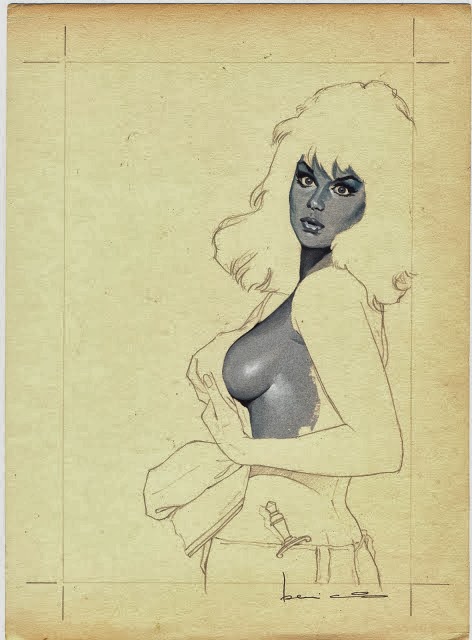
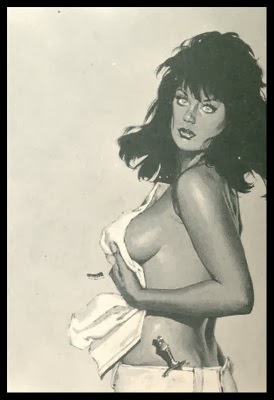

In January of 2011, Benicio was surprised by having
noticed that one of his works was hacked in Germany: the cover of the album
named "Circus Maximus" from the MC Morlockk Dilemma launched that
year is a perfect copy of the cover of another album from 1982 called
"Amar Pra Viver ou Morrer de Amor" from the Brazilian singer Erasmo
Carlos. "That was the first time that I faced a problem of this kind. The
lawyers have negotiated an amicable solution and the case was solved with the
removal of the cover from the market", said Benicio. Check it out:

7) Helio Do Soveral
There is no any explicit evidence on the books, but it
is supposed that Helio Do Soveral has contributed with José Alberto Gueiros,
Director of Editora Monterrey, by writing one or more books in the beginning of
the ZZ7 Collection, probably some of the ones that are claimed to be
self-narratives from characters like Brigitte Montfort or John Pearson (for
instance, Olhar Para A Morte – Book #12, O Trono Escarlate – Book #13 or Whisky
33 – Book #18, all from Red Series).

Known as the writer of 19 aliases, Helio Do Soveral has written approximately 230 books, most of them destined to adolescent readers. Apart of that, he has written screenplays for radio soap-operas as well as for radio and TV shows, and his work includes entire theatrical plays.
In 1965 José Alberto Gueiros invited
Soveral to create his own spy character, someone that should supercede the
success of Giselle and Brigitte Montfort in the Brazilian market of pocket
books. He was very well aware that this mission would not be easy and that his
creation should be something completely out of the box. His most famous
character, therefore, was born under this challenge: Keith Oliver Durban, aka
K. O. Durban and most known as Knock-Out Durban.


Opposite to James Bond, K. O. Durban had an anarchistic mindset and refused to be subject to the orders from the government of any country. He was the owner of an independent island in the Pacific Ocean where he lived with other 6 inhabitants: Gerda Offenbach, his German fiancé that was attended on Mondays; Consuelo, his jealous Spanish fiancé attended on Tuesdays; 瓣 莲 花 (Petal of Lotus), his Chinese fiancé for Wednesdays; Buffalo’s Daughter, his red-skin fiancé of North-American origin who was attended on Thursdays only; Jandira, his Brazilian mulatto fiancé for Fridays and M’Bata, his African origin fiancé for Saturdays. On Sundays K. O. Durban was used to rest. The flag of the island was white having in the middle the figure of two arms showing the famous gesture ‘up yours’, his message to the rest of the world.
His main enemy, Mary Escalder Roosevelt,
aka Maiden of the World, was completely in love for him but she is the only
woman of his relationship that he never laid down with. At the peak, K. O.
Durban Collection sold 70,000 units per book. The Collection comprises 40 books
with 20 double adventures.
A
Tribute From Benicio dated 1998: Helio Do Soveral at 80, his main character K. O. Durban and
some of his fiancés, joined in Aloana Island:

Born on 30 September 1918 in Setúbal, Portugal, Helio Do Soveral Rodrigues De Oliveira Trigo has emigrated to Brazil very young, lived in Rio de Janeiro during approximately 60 years and passed over in Brasília on 21 March 2001.
Sources:
Photos of Benicio and illustration scannings:
www.benicioilustrador.com.br/
Some cover scannings obtained
in the internet
Quotes from Gonçalo Junior´s article published in
Brazilian Playboy, edition March 2013
Dagomir Marquezi's article published on VIP Exame Magazine, May 1998
Dagomir Marquezi's article published on Status Magazine, 1981
Dagomir Marquezi's article published on VIP Exame Magazine, May 1998
Dagomir Marquezi's article published on Status Magazine, 1981


+S%C3%A9rie+Vermelha.jpg)
+S%C3%A9rie+Azul.jpg)

